Imagine, you are in a beautiful forest, walking through the pass among trees and glasses ….How many of us will pay attention to each species of plants. Maybe, we will spot some flowers or a distinguish shape of tree.. but mostly our attention easily goes to somewhere, and the beautiful plants fade out as a green wall. Instead of recognizing individual plants, it becomes a vague background. We definitely notice them and appreciate its beauty, but as soon as a bird song comes, our attention goes to the bird immediately. It can be anything, it could be your accompany, or a phone call, even your daydream is enough to push back all the plants into background. Those our lack of enthusiasm against plants may be something we shouldn’t lightly ignore – maybe we must pay more attention to those insignificant plants.
This art project is a friendly reminder for myself to be aware of the presents of plants.
In Green – Garden Wallpaper Singapore 2026
Date : 2026
Medium : Inkjet (printed on wallpaper)
Dimension : 13’ 1” x 39’ 4”
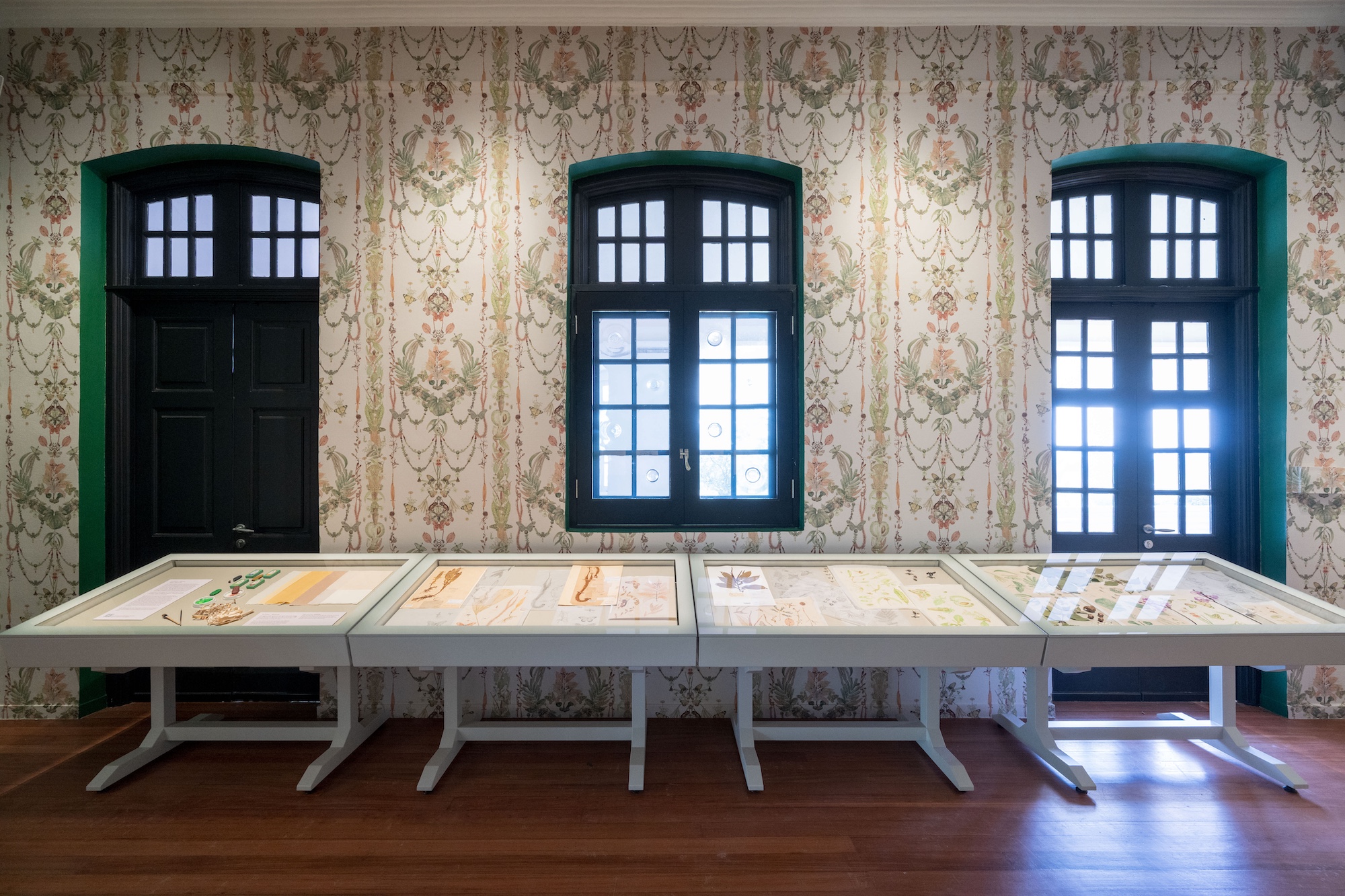
photo by Singapore Botanic Gardens
[CONCEPT]
This wallpaper celebrates Singapore’s biodiversity while reflecting on urgent environmental concerns. Like wallpaper itself, much of the natural world is easily overlooked, receding into the background of daily life. Small insects may seem insignificant, and familiar plants ordinary, failing to capture our attention. The wallpaper works as a reminder and quiet call to notice what is often ignored, while expressing deep admiration for the richness of nature. More than 80% of total biomass on this planet is plants, and the majority of identified species that we know of are insects. It is simply a breathtaking volume. The ever-repeating wallpaper pattern indicates the hope that our beautiful biodiversity will continue forever.
[CONTENT]
If you get close to the wallpaper, you will find plants, insects, and fungi. The pattern is made of wildlife from Singapore – 70 species represented in 85 drawings, divided into three groups.
The first group, drawn in brown, depicts species that once lived in Singapore but are now locally extinct or critically endangered. The plants were drawn from specimens in the Singapore Botanic Garden’s Herbarium, where plant specimens can be studied by botanists, and occasionally artists, while the insects were drawn from specimens at the Lee Kong Chian Natural History Museum. The second group, in light green, shows Singapore native species which can still be found in the wild. The third group, in deep green, represents introduced species. You may spot a familiar flower or butterfly in the tangled image easily, but it may not be easy to say which ones are native and which ones are introduced. Some introduced species may become invasive, damaging the local ecosystems, whilst others are naturalised and quietly coexist among native species.
The division of species into three groups according to current conservation status acknowledges that these categories are not final. In a not-so-distant future, an extinct species may be found again, and others may become extinct.
Beta-For-est wallpaper Germany 2023
Date : 2023
Medium : Inkjet (printed on wallpaper)
Dimension : 9’ 2” x 19’ 8”
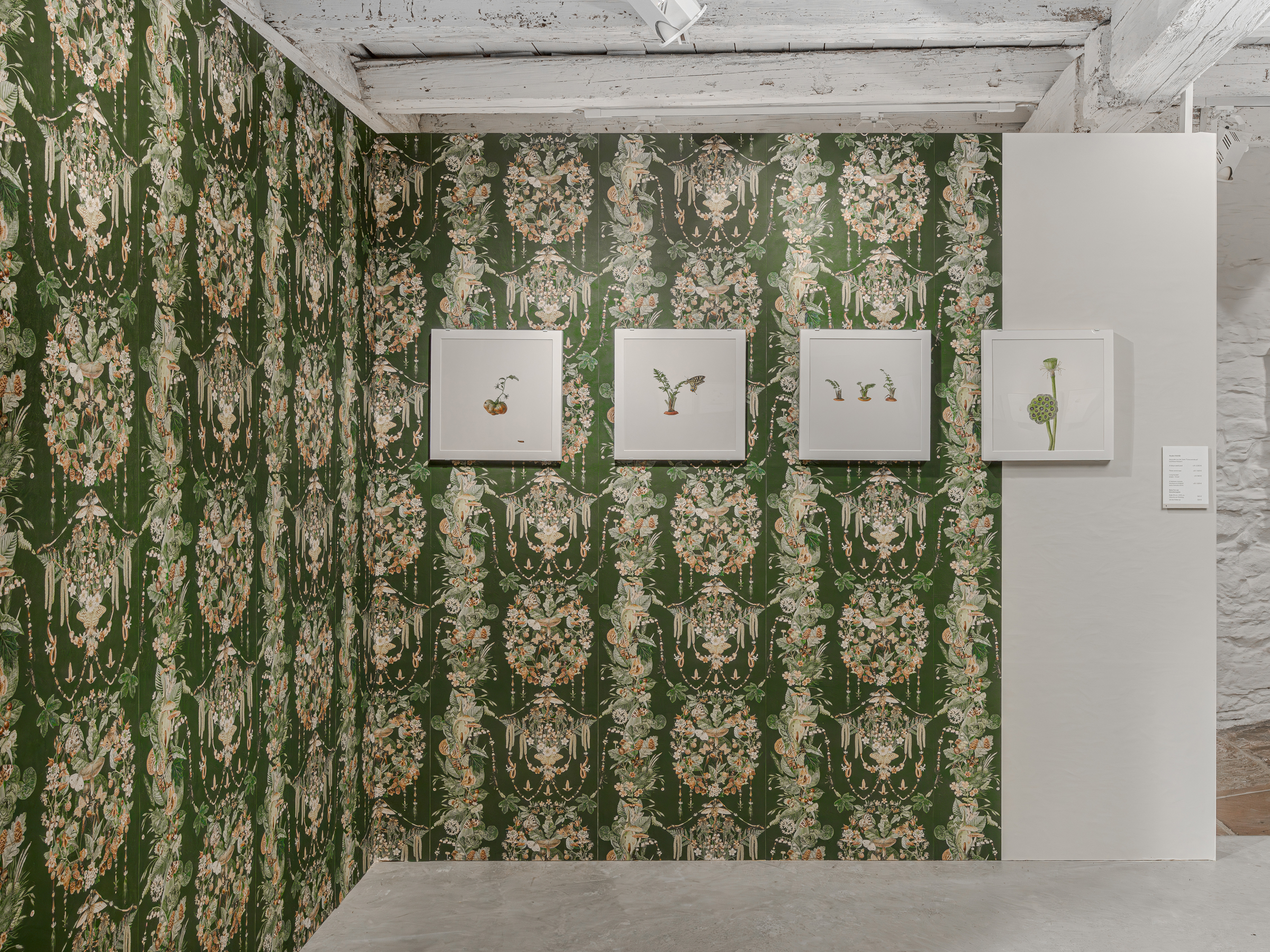
Walking through a thick forest, it feels like I am surrounded by beautiful deep green walls… taking a deep breath, listening to the birds song. We all know how wonderful it is, but are all forests the same? Have you considered how many species in the forest you are in, and do you know what the healthy population looks like?
After the visit to the special forest, Universitätsforstamt Sailershausen, where the university of Würzburg (Julius Maximilians Universität Würzburg) manage and research the new way of support biodiversity by letting dead woods stay on the forest ground after its long life, opened my eyes.
It was semi dark in the dense forest. There was a very old dead wood lying on the ground among low, deep green floor plants, and our guide, Mr.Junginger, one of scientists from the University, pointed some mushroom and a tiny beetle around it. We visited a big open area in the middle of the forest. It was a gap newly appeared after a big tree fell, and now it created a booming new green patch covered with a completely different set of plants. Butterflies were flying under the bright sunshine.
This wallpaper is my reaction inspired by the walk and talk. The research covers a wide range of fields, and the title comes from BETA-FOR, one of the studies of the research. At first, it sounded like “better for”, and later I learned what the BETA-FOR actually means. I simply borrowed the sound, and it carries my hope for better forest, better future.
This is my second wallpaper project, and the first one was about endangered plants and insects in Kyoto, my city of birth. The wallpaper projects are reminders to myself that we can be blind to the beauty and also the devastating problems in nature. Like “wallpaper”, it is there in front of us, but we tend to ignore it as a vague background decoration.
More information about BETA-FOR (The research)
https://www.uni-wuerzburg.de/en/beta-for/about-beta-for/
Red list wallpaper KYOTO 2015
Date : 2021
Medium : Inkjet (printed on wallpaper)
Dimension : 9’ 10” x 32’ 9”

Look close this wallpaper, you can find plants and insects in the pattern. Well, actually the pattern is made from nothing but the plants and insects.
These are all on the endangered red list in KYOTO prefecture researched in 2015.
Because of the lost of habitat due to human activities, or due to overhunting because of its collectable beauty… whatever the reasons are, they are disappearing. The most of those endangered species are plain and mundane looking, I will not notice them in a wild setting unless someone pointed… Probably, I will not know if it is rare, disappearing spices or thriving invasive species. It is the solid fact that we are losing the beautiful biodiversity, but am I aware enough of the sad reality? I am not sure.
This piece is a reminder to myself that we can be blind to the devastating problem. Like “wallpaper”, it is there in front of us, but we tend to ignore it as vague background decoration.
First step of making the wall paper was to draw all plants and insects with thin brushes on Japanese paper like old Japanese natural history illustrations. Unintentionally, the paper and the brushes I used were actually endangered as well. The paper is called NAJIO WASHI (名塩和紙), and the MAKIE brush was a master piece by NAKAMURA KUROBEE. Both has a long history starting from Edo period (1603 -1867). Despite of the sustained tradition, now only two NAJIO paper craftsman studios left. Mr.Nakamura is the 9th generation of the brush making, but he will be the last and no one will take over his skill. We all use paper and brushes everyday, but all are mostly factory made. Thanks to the latest technology, those essentials are now very reasonable and easy-to-get, helping our life to be more convenient and comfortable. The new technology comes, the old ones must go…Well, I wonder if it must be so?
The wallpaper pattern is made up of intertwined plants and insects. Among them, my worries, anxieties, and even a glimmer of hope are interwoven into it, too. I don’t know if that will come across to the viewers. This project is more of a reminder for myself, but I might still be waiting and hoping for someone to look back on it and realize what are here. A little hope there.
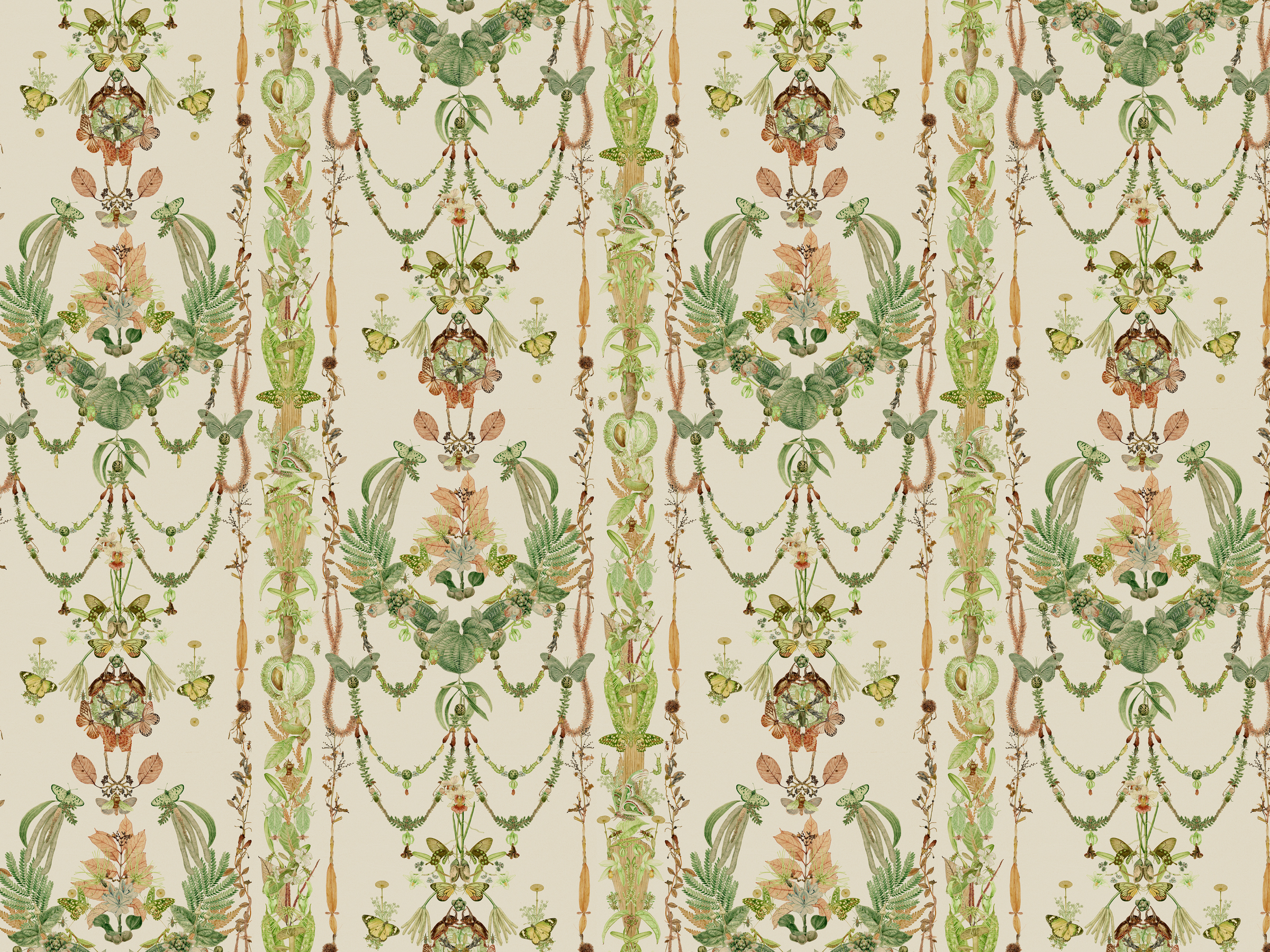
In Green - Garden Wallpaper Singapore 2026
Wallpaper pattern
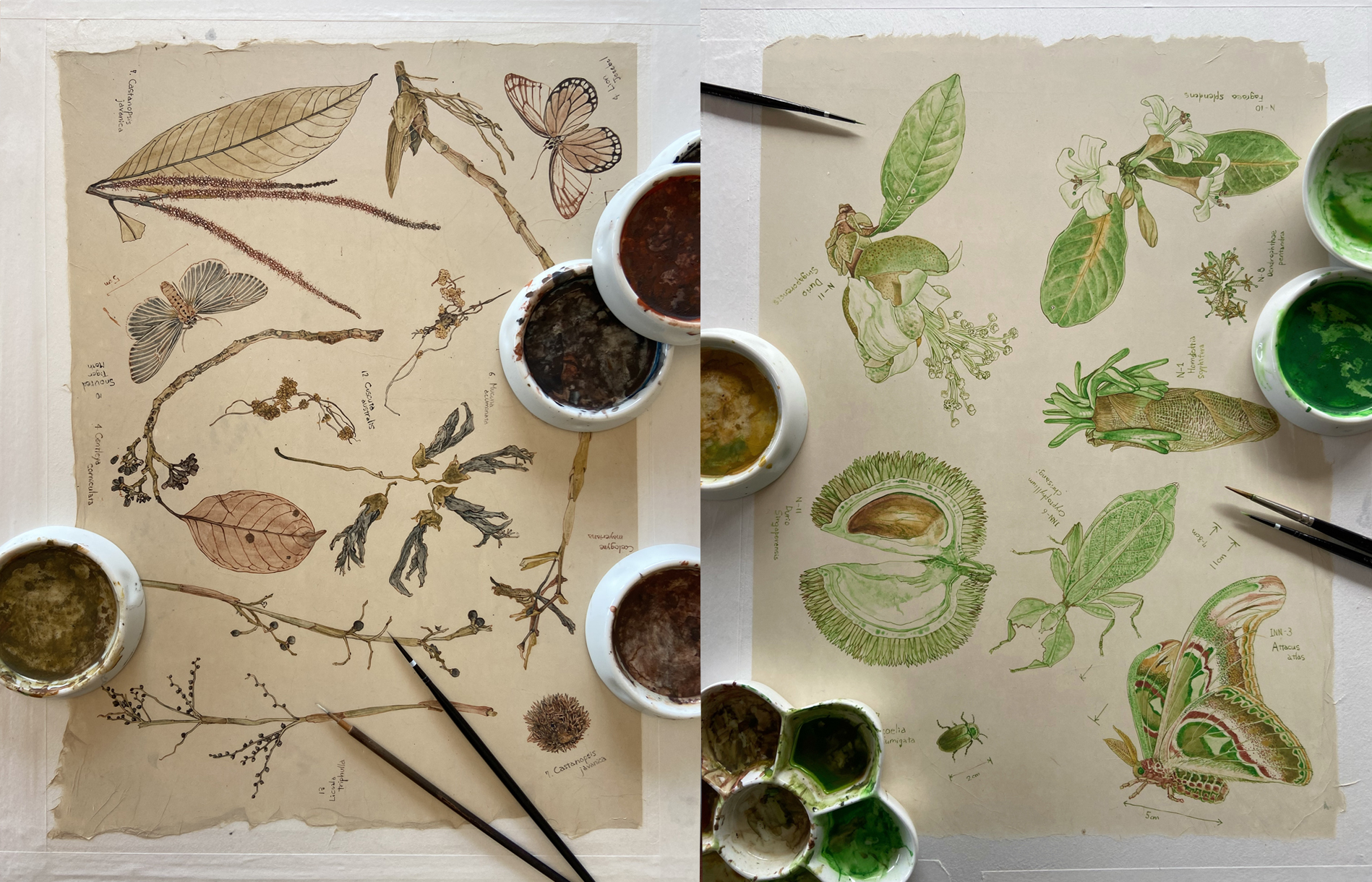
In Green - Garden Wallpaper Singapore 2026
Irozumi 色墨 (Colored ink stick) on Japanese paper
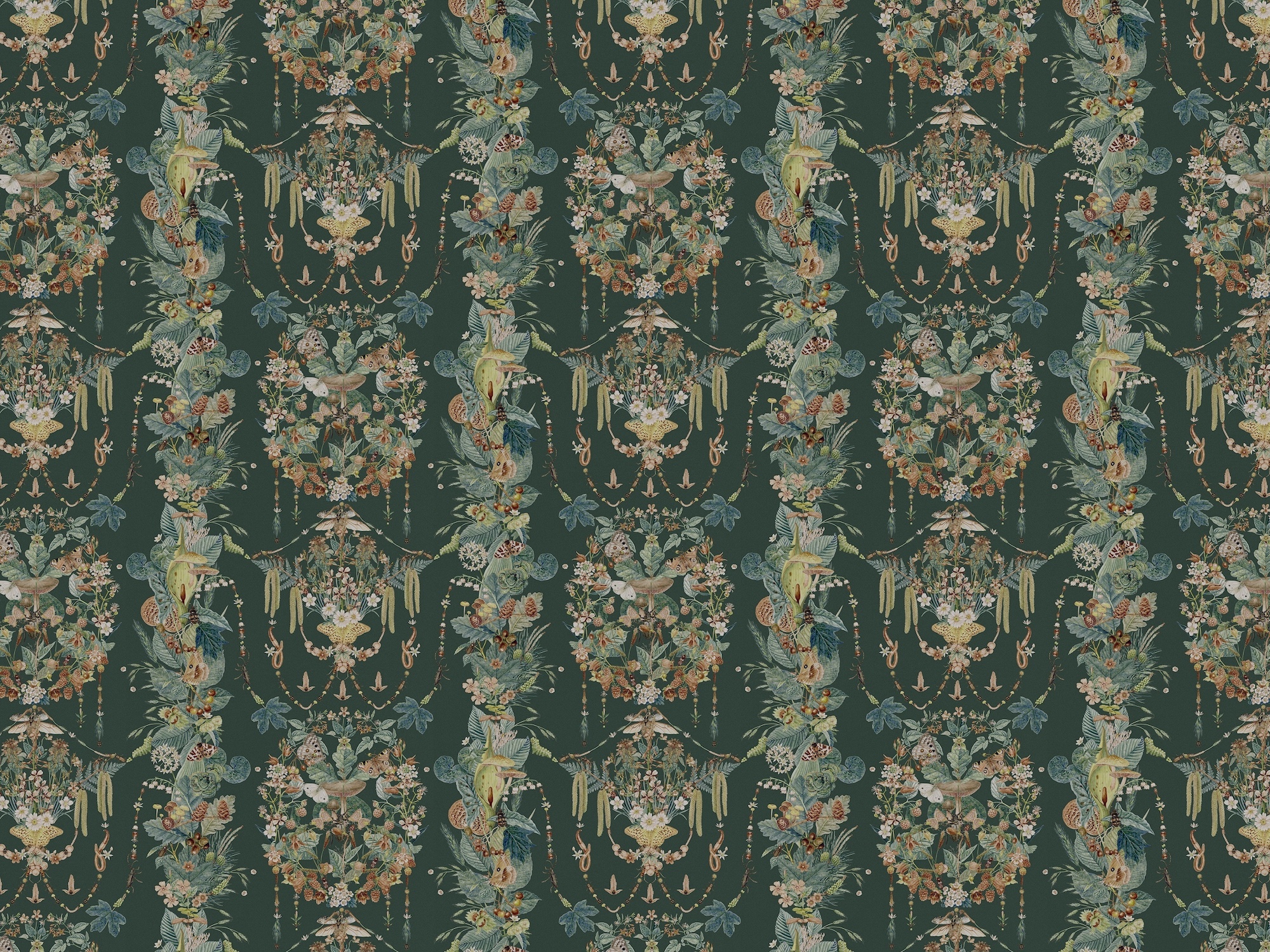
Beta-For-est wallpaper Germany 2023
Wallpaper pattern
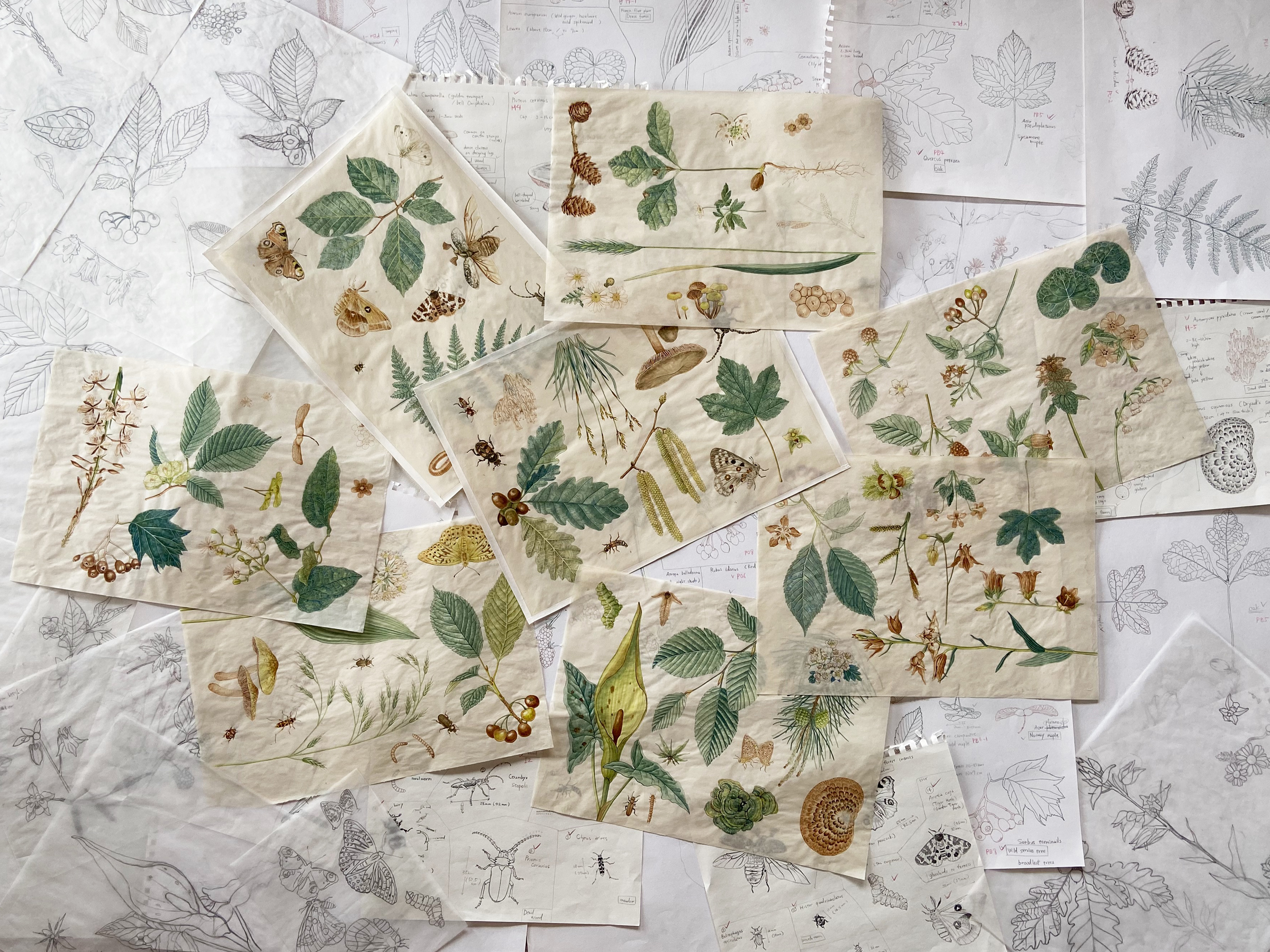
Beta-For-est wallpaper Germany 2023
The drawings, underdrawings,
and under, under drawings
Watercolor on Japanese paper, Pen and ink on tracing paper
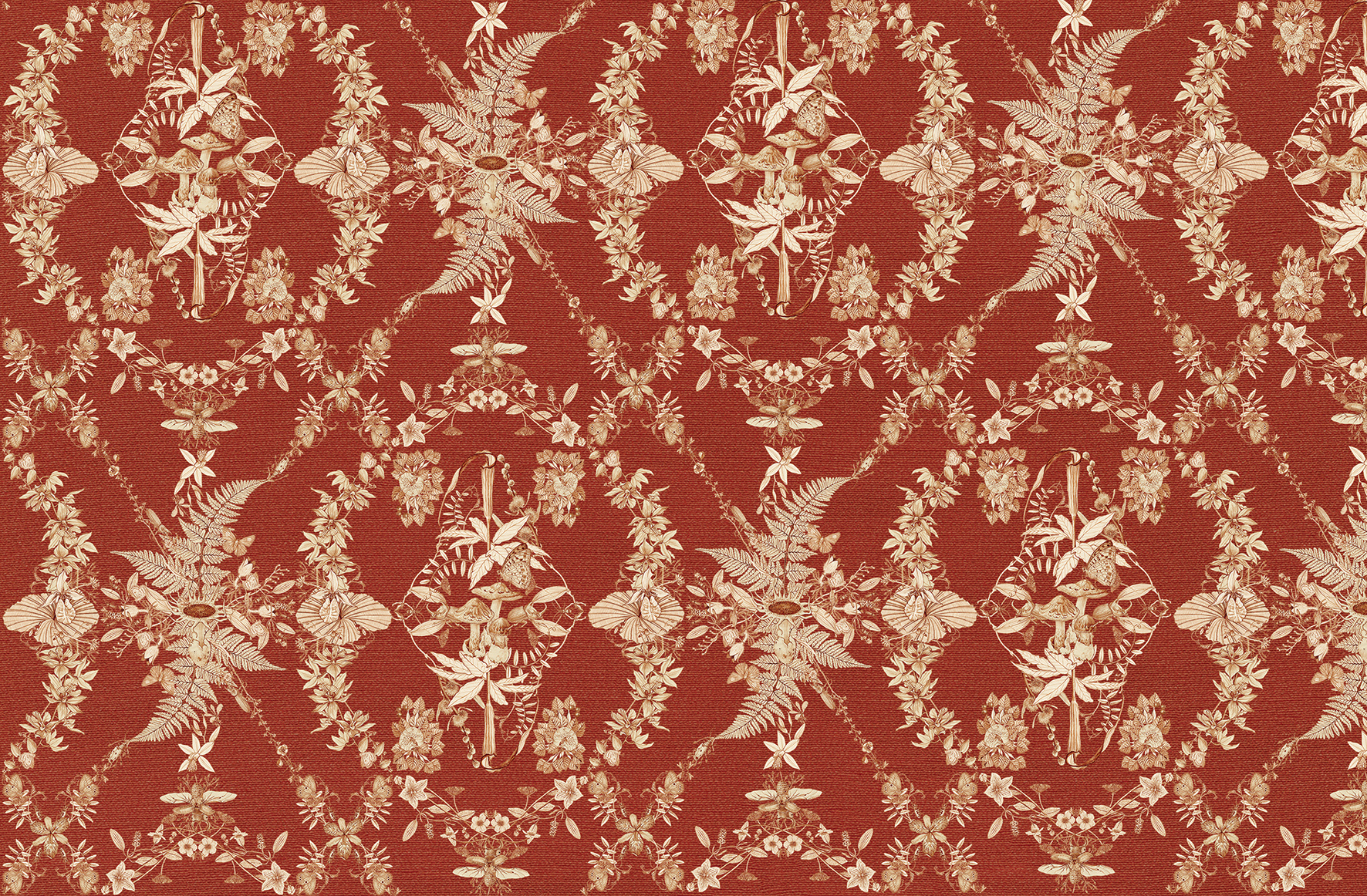
Red list wallpaper KYOTO 2015
Wallpaper pattern
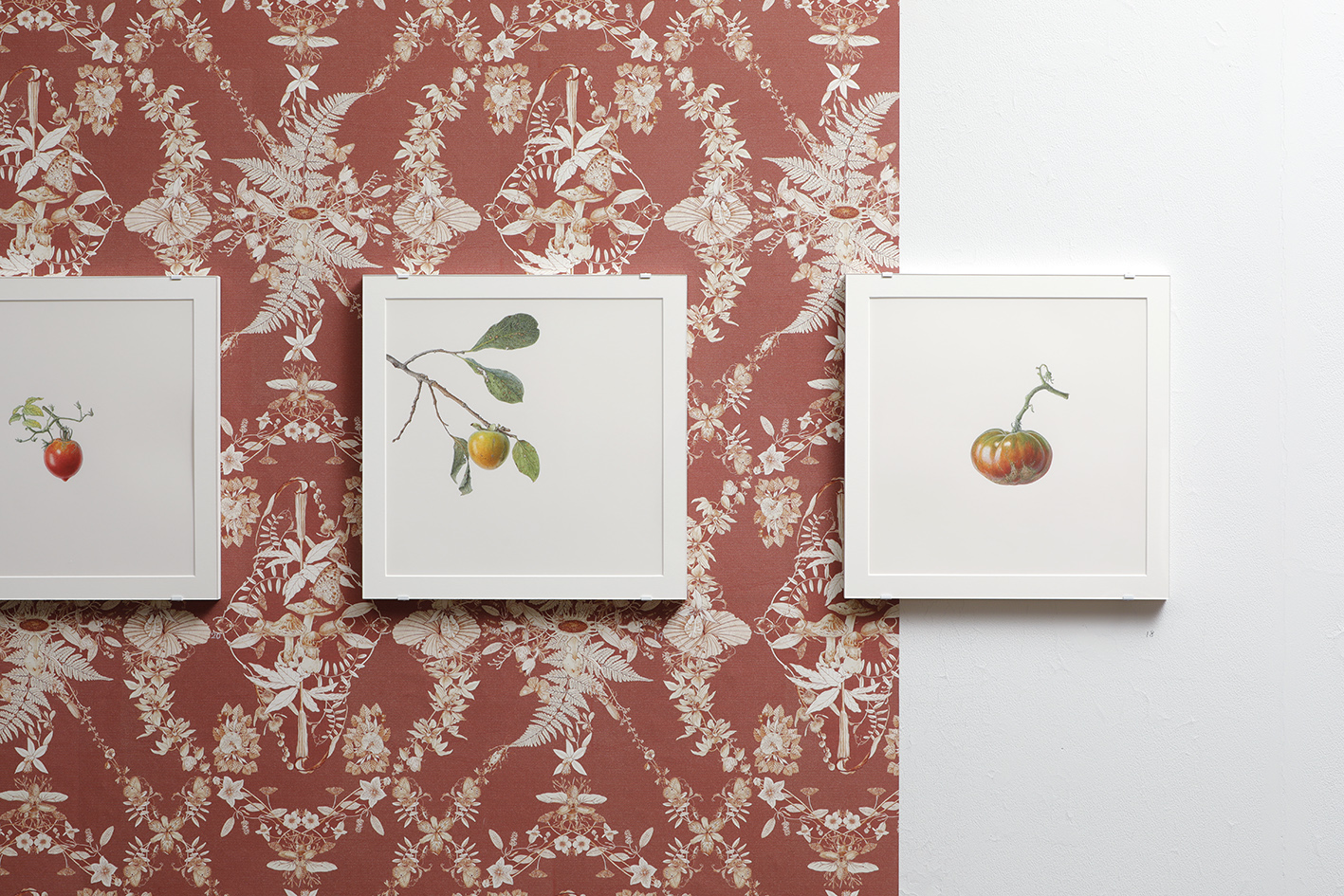
Red list wallpaper KYOTO 2015
Installation view : Still, life - まだ、生きてます @KCUA gallery, Kyoto Japan 2021
Photo by Takeru Koroda
